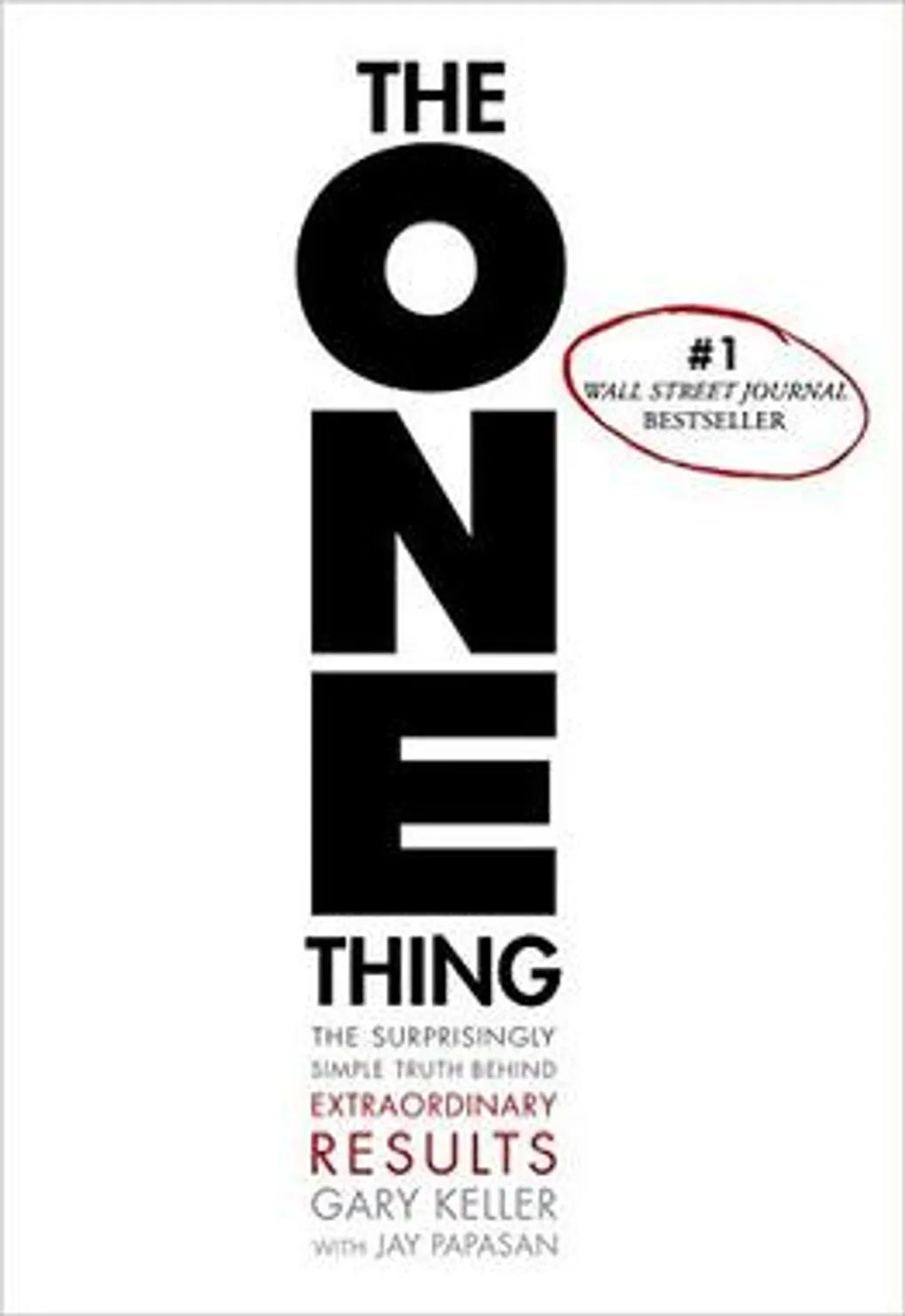
The One Thing book review
Introduction and Context
I listened to this on Audible and it’s an excellent and engaging book on the subject of productivity. The author’s style is very easy to follow - he speaks in plain English and doesn’t lose the message in cliches and metaphors.
My usual way of taking notes is by highlighting passages that resonate with me as I read along in my reading app (Kindle). I can then export all the highlights (and notes) at the end. For an audiobook however I took notes by dictating reminders with Siri - so not quite a smooth experience but meant I could at least capture the ideas.
Of course the best way to cement the learning is to then summarise the information myself - hence the blog post - rather selfish of me I admit!
Key Concept - The One Thing
The key concept of the book is clearly “the one thing” asked as a focusing question - “==what’s the one thing I can do to make _____ easier or unnecessary==”. And it is the framing of goals and actions as a thoughtful question that is, I think, the stroke of genius. Because to get a good answer you need to ask a good question. By asking a good question you don’t choose the easiest action, but instead choose the action that makes everything else easier. Allowing some momentary consideration because of the focusing question makes you arrive at a better answer and therefore a clearer overall direction. You end up doing what’s important, what matters.
Here are some examples:
- For my , what’s the one thing I can do to
in . - E.g. For my health (area of interest), what’s the one thing I can do to *lose 1kg of body fat *(goal) this month (timescale).
- E.g. For my physical well-being what’s the one thing I can do to ensure that I exercise everyday.
A key premise of doing just one focused thing at a time is the avoidance of the fallacy of multitasking. Multitasking is an efficiency-killer. Don’t do it. You lose time context-switching and task-switching. This requires ==discipline== in sticking to your “one thing”, but you’ll reap the rewards for doing so.
Apply discipline in forming ==habits==. Habits lead to outstanding results over the long term. This is due to gradual compounding over time, but does require patience. ==You are what you repeatedly do==. Achievement isn’t an action you take or a state you attain, but a habit you forge into your life, day-in, day-out.
Meaning and Purpose
There is also a good summary of the importance of seeking meaning and purpose. Purpose is the combination of where we’re going (goals) and what’s important to us (meaning). This is inexplicably linked to happiness, with nice quote that “happiness lies on the road to fulfilment”. This speaks to me because happiness is to some extent a choice - a choice in where you find meaning, purpose and fulfilment.
The book also explains “balance” in the best way I’ve heard. There is no work-life balance - it’s not a final state you can attain but a continuous, dynamic ==act of balancing==. This is powerful and speaks to the fact that everything changes and being adaptable and agile is crucial. To visualise this act of balancing I imagine the Cartpole problem from Machine Learning fame - basically an inverted pendulum. It takes continuous adjustment - either micro corrections or more major corrections, but you never achieve balance, it’s a continuous process.
Goals
I really like the goal setting framework in the book; starting with a someday goal and breaking it down into ever small milestones until you have the focus question, “what’s the one thing I can do right now?”.
For goals think big and specific. For example, what’s the one thing I can do to double sales in** 6 months**.
There is a link between your meaning and purpose, and then the priority that provides and the resulting productivity on a daily basis. Summarised as:
- Purpose → Priority → Productivity
Productivity can only come from a solid foundation of purpose with a clear sense of priority. To bypass Purpose and Priority is to lose the true value in Productivity. There’s no point in being productive for the sake of it, it has to move the needle in a real and positive sense.
The author summarises the focus time given to the One Thing, typically in the morning for the first half of the day, as “be a maker in the morning and a manager in the afternoon”. The One Thing should be about creating, and that’s best done in the morning. We all have other things to manage in our lives however and that is the role of the manager in the afternoon - to tend to meetings, phone calls, and everything else.
Time Blocking
You should block time (in this order) for:
- Recreation
- Your One Thing
- Planning
Take care of yourself first essentially, then do what matters, the plan ahead to be clear of goals and to block time for next week.
Accountability
Be accountable not a victim of your own life. This is a very important concept and covered in a much more motivating way in Extreme Ownership by Navy SEALs Jocko Willink and Leif Babin. In summary, take accountability for everything in your life and start owning your life.
Overall
Overall I’d give this book 4/5 as an solid and motivational productivity book. Whilst a good listen as an audiobook don’t forget to check out the figures from the book at the book’s website. I’m still debating the value of audiobook listening on the go with the lower quality of notes. We’ll see how it goes. I have other books to add here shortly, from book and audiobook form.