Error Found in Timoshenko’s Vibration Problems in Engineering
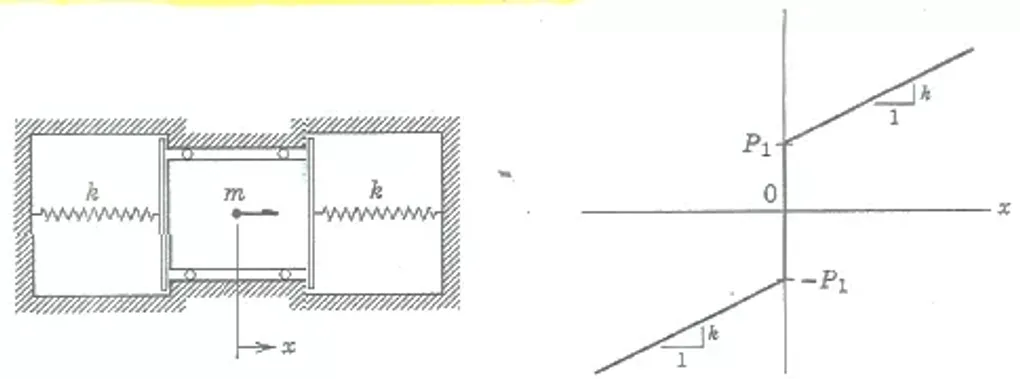
Timoshenko’s “Vibration Problems in Engineering” (4th Edition, 1974) gives an example (2.5-9) for the displacement and frequency of a simple system involving a mass and two springs under preload. The example is shown in the figure below.
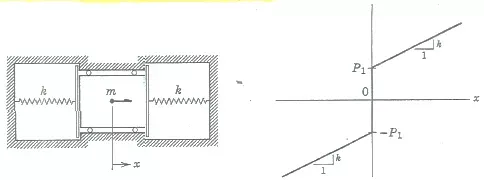
Problem 2.5-9 from Timoshenko’s Vibration Problems in Engineering
Timoshenko gives the following formulas for period and displacement amplitude, a mass with the initial conditions and as:
Where:
is the period in seconds
is the radian frequency in rad/s,
is the spring stiffness in N/m
is the initial velocity in m/s
is the spring preload in N
is the peak amplitude in metres
is the mass in kg
Note that there is an error in the text book for the formula for period, where the factor of 2 should in fact be 4. This becomes apparent in the limit for (i.e. no preload) where the period should be:
But given that the original Timoshenko formula would yield:
This is incorrect, and out by a factor of 2.
The corrected formula for period is therefore (see full derivation below):
Derivation of Corrected Formula for Timoshenko Problem 2.5-9
The equation of motion for the example problem 2.5-9 is:
Which can be written:
The right hand term in the above equation is a constant and Timoshenko suggests that this be considered as a pseudostep function applied to a system with mass and spring stiffness .
By this approach the total response may be calculated as the sum of the effects of the initial conditions and the influence of the pseudostep function.
The displacement due to free vibration, where the initial displacement , is given by:
Where:
is the peak displacement amplitude
The displacement due to a step force that jumps from zero and is then held at a constant value is given by:
According to Timoshenko, the total response is the combination of the two components, noting that for this case the step force is negative relative to the direction of motion:
Which can be rewritten:
Differentiate to obtain the velocity:
The time of maximum response occurs when :
The above equation is the time to go from zero to maximum displacement. In terms of the full harmonic motion, this therefore represents ¼ of the period. Therefore the period is:
This is therefore the corrected equation for the period for problem 2.5-9.
Closing Remarks
This error demonstrates the need to question everything, and highlights the importance of verification. This error was first spotted when the results from a finite element analysis of this problem done as part of a verification activity yielded different answers.